🚤 Top 3 Rules of the Road Every Central Florida Boater Should Know
By Captain Mike Rice, USCG-licensed captain • Central Florida Boating Association
If you want to learn to boat in Central Florida, this is the stuff that actually keeps you out of trouble on Lake Toho, the Conway Chain, Butler Chain, Harris Chain, and the St. Johns River.
Not “boating etiquette.”
Not marina gossip.
The real rules of the road — the Inland Navigation Rules that Florida law says you have to follow.
Florida Statute § 327.33(3) is blunt:
“Each person operating a vessel upon the waters of this state shall comply with the navigation rules.”
Break them and cause an accident with serious injury or death, and it can become a crime. Even a “simple” violation is a ticket.
Below are the three meeting situations every beginner in Orlando boating lessons should memorize: head-on, crossing, and overtaking. I’ll give you the legal wording first, then the dock-talk version.
✅ Quick terms you’ll hear in any powerboat lesson Orlando captains teach
Give-way vessel = you must change course or speed early and obviously
Stand-on vessel = hold course and speed so the other boat can predict you
Starboard = right
Port = left
⚠️ Important: Nobody gets a free pass to hit somebody. If the other skipper freezes, you still have to avoid the collision.
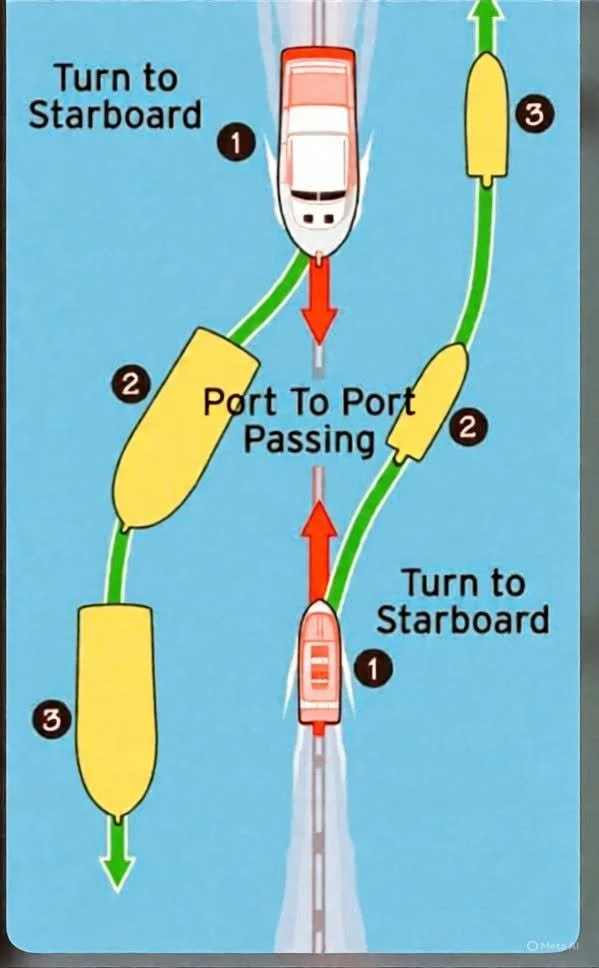
🟡 Rule #1 — Head-On: Both Boats Go Right
(Inland Rule 14 • 33 CFR § 83.14)
📜 The law (word for word):
“(a) Unless otherwise agreed, when two power-driven vessels are meeting on reciprocal or nearly reciprocal courses so as to involve risk of collision each shall alter her course to starboard so that each shall pass on the port side of the other.”
“(c) When a vessel is in any doubt as to whether such a situation exists she shall assume that it does exist and act accordingly.”
🧠 Layman terms:
Two powerboats coming straight at each other? Both turn right. You pass left-side to left-side — port-to-port.
Think two cars on a two-lane road. You don’t play chicken. You don’t “hold the middle because I was here first.”
If you’re not sure it’s head-on or a crossing, treat it as head-on and go right.
📍 Central Florida picture:
You’re in a cut on the Conway Chain or a canal off the Harris Chain. Another pontoon is coming the other way. Both of you ease right. Easy Saturday. The wrecks happen when one guy hugs the “wrong” bank and the other guesses.
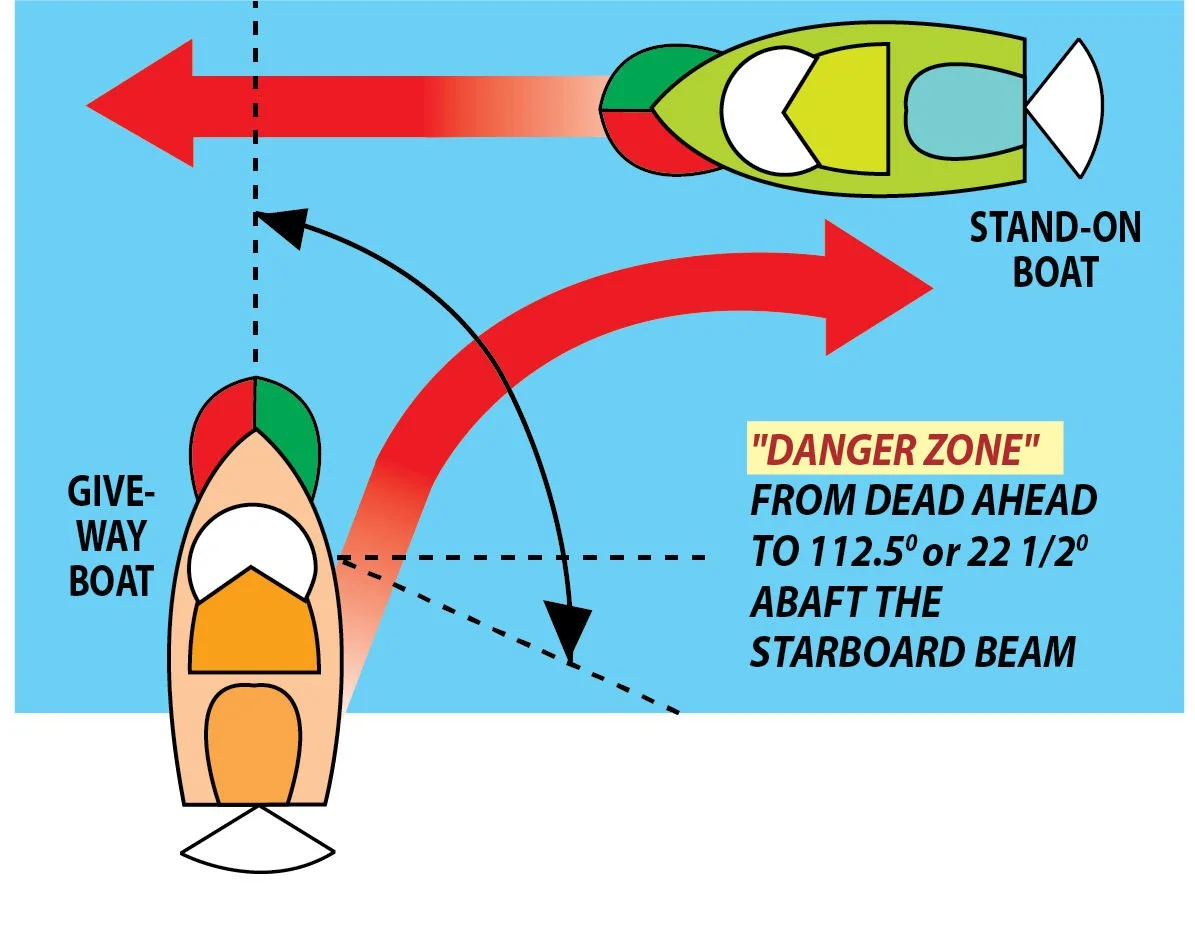
🟡 Rule #2 — Crossing: The Boat on Your Right Has Rights
(Inland Rule 15 • 33 CFR § 83.15)
📜 The law (word for word):
“(a) When two power-driven vessels are crossing so as to involve risk of collision, the vessel which has the other on her starboard side shall keep out of the way and shall, if the circumstances of the case admit, avoid crossing ahead of the other vessel.”
🧠 Layman terms:
If another powerboat is crossing your path and it’s on your right (starboard), you give way. Slow down, stop, or turn. Do not cut across their bow.
If they’re on your left (port), you are the stand-on vessel. Hold course and speed so they can miss you cleanly.
Night memory trick I use in on-the-water boating lessons:
🟥 See a red sidelight on your right = give way.
🟩 See a green sidelight on your left = hold steady (but stay ready).
📍 Central Florida picture:
Open water on Toho or Butler. You’re running toward the sandbar. A deck boat is coming across from your starboard. That’s your yield. Don’t “I can beat him.” That’s how rental weekends turn into insurance claims.
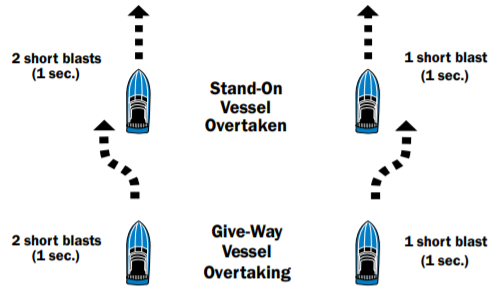
🟡 Rule #3 — Overtaking: The Boat Passing Always Gives Way
(Inland Rule 13 • 33 CFR § 83.13)
📜 The law (word for word):
“(a) Notwithstanding anything contained in Rules 4 through 18 (§§ 83.04 through 83.18), any vessel overtaking any other shall keep out of the way of the vessel being overtaken.”
“(b) A vessel shall be deemed to be overtaking when coming up with another vessel from a direction more than 22.5 degrees abaft her beam; that is, in such a position with reference to the vessel she is overtaking, that at night she would be able to see only the sternlight of that vessel but neither of her sidelights.”
“(c) When a vessel is in any doubt as to whether she is overtaking another, she shall assume that this is the case and act accordingly.”
“(d) Any subsequent alteration of the bearing between the two vessels shall not make the overtaking vessel a crossing vessel within the meaning of these Rules or relieve her of the duty of keeping clear of the overtaken vessel until she is finally past and clear.”
🧠 Layman terms:
Coming up from behind? You stay clear until you are all the way past.
Doesn’t matter if you’re faster, newer, a ski boat, or “just sliding by on plane.” The boat ahead is stand-on. Your wake is your problem.
“More than 22.5 degrees abaft the beam” = basically from behind, not from the side. If you’re unsure whether you’re overtaking or crossing, the rule says assume you’re overtaking.
📍 Central Florida picture:
A slow pontoon is idling toward a dock on Lake Maitland. You want by. Give them room, pass wide, and don’t bury their swim platform in your wake. Same rule when you’re tubing and a family rental is ahead of you.
🛟 The rule behind the rules (this is the one courts care about)
(Inland Rule 2 • 33 CFR § 83.02)
📜 The law (word for word):
“(a) Nothing in these Rules shall exonerate any vessel, or the owner, master, or crew thereof, from the consequences of any neglect to comply with these Rules or of the neglect of any precaution which may be required by the ordinary practice of seamen, or by the special circumstances of the case.”
🧠 Layman terms:
You don’t win the argument because you “had the right of way.”
Right of way is a duty, not a trophy. If a collision is coming and you can still prevent it, prevent it.
That’s why our boating lessons in Orlando spend as much time on lookout and safe speed as they do on “who yields.”
✅ 30-second cheat sheet (screenshot this)
Head-on → both turn right, pass port-to-port
Crossing → boat on your starboard = you give way
Overtaking → passer keeps clear until past and clear
Doubt? → assume the more conservative rule
Collision developing? → both boats must act
🎓 Want to actually learn this on the water?
Reading this helps. Muscle memory helps more.
If you’re searching boating lessons Orlando, learn to boat Central Florida, powerboat lessons, or a Florida boating safety course plus real helm time, that’s what we do at the Central Florida Boating Association.
Our USCG-licensed captains teach National Safe Boating Council on-the-water modules:
Intro to powerboating
Docking
Open-water maneuvers
Ages 14+. Your boat or ours. Lakes around Orlando — the same water you’ll actually boat.
👉 Book lessons: Click Here
📌 Florida reminder: if you were born on or after January 1, 1988, you generally need a Florida Boating Safety Education ID Card to operate a motorboat 10 HP or more. The online course is the classroom piece. On-the-water training is how it sticks.
See you on the water — and keep it to the right when you’re meeting bow-to-bow.
— Captain Mike
Central Florida Boating Association